
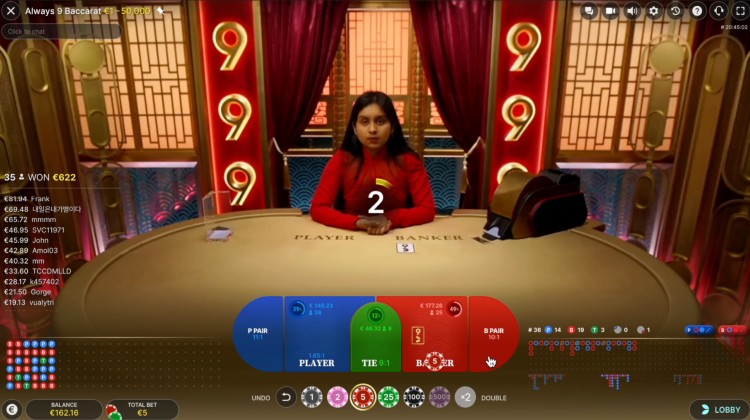
What Insurance Baccarat Really Is and How It Works
Insurance baccarat is a variant of traditional baccarat that adds an extra bet allowing players to hedge against specific losing outcomes, usually when their chosen hand looks strong after the initial cards. The concept introduces a trade‑off: players give up part of their potential profit in exchange for conditional protection that only pays under narrowly defined scenarios, which changes the volatility of results but not the underlying house advantage.
Why Insurance Baccarat Exists in the First Place
The idea behind insurance versions of baccarat is to monetise a common emotional pattern: players feel most frustrated when a strong initial hand loses to a perfect or near‑perfect opposing hand. By offering an insurance option at this exact moment, casinos convert that frustration into a side bet that promises compensation if the strong hand ultimately fails, which increases game engagement while also adding a new revenue stream through a higher house edge on the insurance wager.
Basic Structure of Insurance Baccarat
In formal rule sets, insurance baccarat keeps the standard main bets—Player, Banker, and Tie—but adds an insurance bet offered after the initial cards are exposed, subject to specific conditions such as minimum hand totals. The insurance amount is usually capped at or below the original main bet, and pays out at fixed odds only if the insured hand ends up losing in particular ways, such as losing to an opposing total of nine, while resulting in a loss or push under other outcomes.
Mechanism of the Insurance Bet in Practice
The mechanism can be understood as a derivative bet keyed to the fate of the initially stronger hand, with rules designed to favour the house across all possible card paths.
| Step in the hand | What the player sees | Insurance offer condition | Typical insurance resolution |
| After two or four cards dealt | One side shows a strong total (e.g., 6–9) | Insurance may be offered on that strong side only | Wins if that side later loses under defined cases |
| Before drawing third cards | Player decides whether to buy insurance | Amount limited to a fraction or equal to main bet | Pays at fixed odds or loses/pushes per paytable |
| After final totals are known | Main bet is settled first | Insurance bet then settled according to paytable rules | Often lost when main bet wins or loses in “uninsured” ways |
By binding insurance eligibility to specific totals and outcomes, the structure ensures that the side bet is profitable for the house over time, even though individual players may occasionally feel “rescued” when a strong hand collapses and the insurance pays. The overall impact is that volatility shifts from the main bet to the combined main‑plus‑insurance position, where apparent protection hides an increased average cost per hand due to the side bet’s higher edge.
Example Scenarios of Insurance Baccarat Hands
In many implementations, insurance can be offered when the insured hand has a high total—commonly between 6 and 9—because these spots create the perception of being ahead, even though third‑card rules can still reverse the outcome. For instance, a player who backs the Player hand and sees an initial total of 8 might be able to buy insurance that pays if Banker draws to a 9 and wins, creating a situation where a painful reversal triggers a partial or full payout on the side bet.
Another variant described in rule documents and patent filings offers insurance when either side shows a natural 8, with the insurance paying if the opposite side hits a natural 9, pushing if both sides show 9, and losing in most other outcomes. In both examples, the structure focuses payouts on rare, emotionally charged outcomes, encouraging players to accept a consistent small cost—in the form of many losing insurance bets—to guard against occasional dramatic swings that are, in reality, part of normal baccarat variance.
Payout Tables and House Edge in Insurance Baccarat
Official rule sheets emphasise that insurance wagers pay according to a separate pay table, often with odds in the range of 4:1 to 8:1 depending on specific hand totals and whether Player or Banker is insured. While these odds look attractive, analytical work and side‑bet evaluations show that the true probabilities of the insured events are lower than the displayed payouts would suggest, creating a significant edge for the house that is usually higher than on the main baccarat bets.
In addition, many rules cap the combined return of initial and insurance wagers so that, even when the insurance hits, the net profit relative to the original stake remains modest compared with the risk undertaken across many hands. By limiting maximum effective coverage and structuring payouts to favour rare events, casinos ensure that players who habitually buy insurance pay a premium over time, even if their short‑term records contain several memorable “rescues.”
Bankroll Implications of Using Insurance Regularly
From a bankroll perspective, consistently purchasing insurance changes the betting profile from a single bet per hand to a bundled position that behaves more like a main bet plus a recurring side wager. Each insurance purchase increases the average stake at risk per round, which accelerates bankroll turnover and amplifies the long‑term effect of the side bet’s higher house edge, even when individual rounds feel safer because worst‑case scenarios appear cushioned.
Over many sessions, this structure can shift the bankroll trajectory from relatively slow erosion under standard Player/Banker bets to a steeper decline that is harder to detect because losses are spread across both main and insurance wagers. Players who treat insurance as a default habit rather than an occasional, consciously priced hedge often underestimate how much of their expected loss stems from the insurance component rather than the base game itself.
Comparing Insurance Baccarat to Standard Baccarat and Other Side Bets
Compared with vanilla baccarat, insurance versions add complexity by allowing multiple decision points and additional payouts, but they do not improve the underlying statistical position of the player. In effect, insurance functions similarly to other baccarat side bets that trade simple, low‑edge wagers for more intricate structures with higher potential payouts and significantly higher long‑run costs, shifting the experience toward higher volatility and greater house profitability.
A key distinction is that insurance bets are framed as protection rather than as pure gambles, which can make them more psychologically appealing than conventional side bets even when the math is comparable. Because of this framing, players may overestimate the benefit relative to classic wagers and underestimate the cumulative impact on their bankroll, especially when sessions are short and dominated by a few extreme hands that insurance happened to cover.
Conditional Scenarios Where Insurance Changes Outcomes
Looking at conditional scenarios clarifies where insurance alters the distribution of results and where it leaves the final outcome untouched.
- When a strong insured hand wins normally, the main bet profits and the insurance bet typically loses, reducing net gain relative to not buying insurance.
- When a strong insured hand loses in the exact way specified by the pay table, the main bet loses but the insurance bet pays, converting a pure loss into a partial or full recovery.
- When the final outcome falls outside the insured conditions, both the main bet and insurance may lose, worsening the result compared with playing the base game alone.
These conditions show that insurance does not consistently reduce risk; it reallocates it into specific branches of the game tree, rewarding some rare reversals while increasing average cost in normal wins and routine losses. For players evaluating whether to use insurance, understanding these branches is more informative than focusing solely on isolated instances where insurance “saved” a hand.
Insurance Baccarat in Online Live-Dealer Settings
In modern live‑dealer formats, insurance baccarat often appears alongside standard tables, with digital interfaces prompting players to accept or decline insurance when qualifying hands occur. These prompts are timed to coincide with moments of perceived advantage—such as when the chosen side is initially ahead—which heightens emotional engagement and encourages impulsive acceptance of the offer, particularly among players who focus on individual hands rather than long‑term expectation.
Because online dealing speeds and continuous shoe availability increase the number of hands per hour, the cumulative effect of repeated insurance purchases grows faster than many players anticipate. In this setting, using session limits and clear rules about when, if ever, insurance will be bought becomes crucial for maintaining control over the increasing cost per hand introduced by the variant.
When a bettor navigates an online gambling environment that provides multiple baccarat rule sets in one place, that variety creates both opportunity and risk: encountering insurance versions alongside standard tables means the person can experiment with structures but also must distinguish between base‑game edges and those of specialised options; within such a context, referencing บาคาร่าออนไลน์ as a representative betting destination highlights how clear rule descriptions and on‑screen pay tables are essential for assessing whether the trade‑off in insurance baccarat aligns with the player’s tolerance for complexity and additional house edge.
Relationship Between Insurance Baccarat and casino online Choices
From the perspective of game selection, insurance baccarat is one of several variants that can appear across different digital operators, each with small rule nuances that affect payouts and risk. The decision to gravitate toward or away from insurance tables sits alongside broader casino online choices about side bets, table limits, and rule transparency, because each layer of optional complexity has a compounding effect on overall expected loss and perceived control.
Players who approach online baccarat with a risk‑management mindset often favour simpler tables where the primary edge is clear and extra bets are limited, reserving insurance variants for occasional, consciously measured experiments rather than routine play. Viewing available games through that lens—prioritising clarity of odds over short‑term excitement—helps prevent the incremental creep of higher‑edge features that collectively make long‑term survival of the bankroll less likely.
Summary
Insurance baccarat adds a hedging side bet to standard baccarat, offering conditional protection when a strong hand later loses, but this protection comes at the cost of a higher house edge embedded in the insurance pay table. Understanding when the insurance bet is offered, how payouts are calculated, and how repeated use affects bankroll volatility enables players to treat the variant as an informed choice rather than a default safeguard, preserving a clearer view of long‑term risk in both live and online play.